Coilovers vs Lowering Springs: Choosing the Right Setup for Your BMW
Springs keep your factory dampers; coilovers replace them. What each changes on a BMW, how Adaptive M suspension affects the choice, why the alignment matters, and when each setup is worth the money.
In this article
Coilovers vs lowering springs is really a question about the dampers. Lowering springs change ride height and spring rate but keep the factory shocks, while coilovers replace spring and damper with one height-adjustable unit. For a street-driven BMW with healthy dampers, the right springs plus an alignment usually deliver the look and a tidier feel. Coilovers earn their price when you will actually use the adjustment: track days, corner balancing, or a ride height that springs can't give you.
Coilovers vs lowering springs: what each changes
Each corner of the car does three jobs. It holds the body at a ride height, it resists compression (spring rate), and it controls how quickly the spring moves (damping). BimmerWorld's suspension basics page sums up the damper's role: "The damper's purpose is to control the motion of the spring and the rest of the suspension."
Lowering springs swap only the springs. FCP Euro's guide to lowering a car notes that they "are generally stiffer than those they replace to compensate for the reduced travel," and that shorter travel makes the damper "far more likely to bottom out." The drop is fixed by the part number. In its springs-versus-coilovers comparison, the parts retailer OneFastShop lists H&R's G80 M3 Sport set at 1.2 inches front and 0.4 inches rear. The "average" drop in a brand's marketing and the drop on your car are often different numbers.
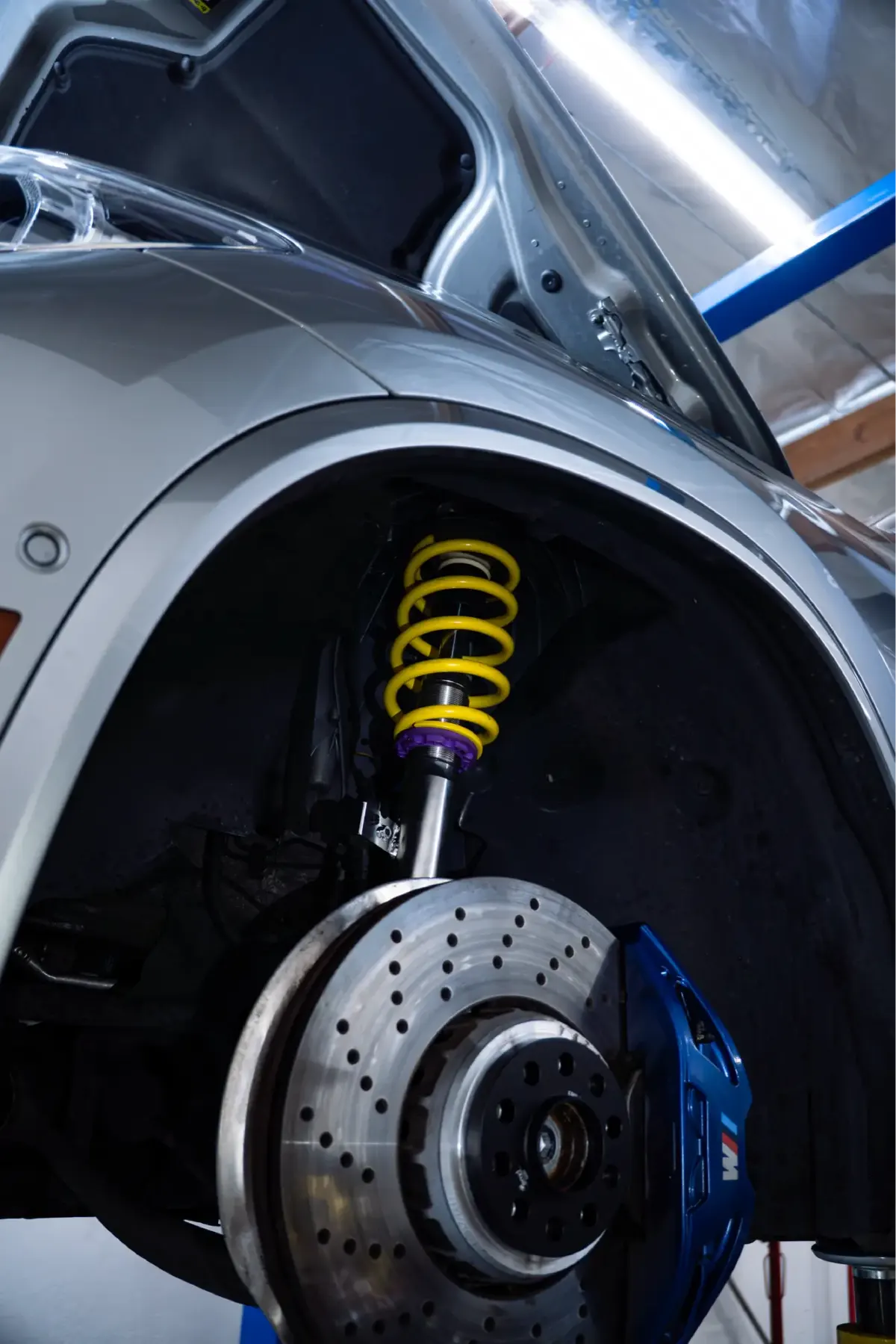
Coilovers put the spring on a threaded perch around a damper built for that spring. You get ride height adjustment at each corner and, on most kits, damping adjustment as well. BimmerWorld's street suspension guide points out that they "require ride height adjustments and measurements post-install." It also warns that street kits are not track kits: "Don't mistake them for track or race coil overs."
Height-adjustable springs sit in between. They put the spring on a threaded perch but keep the factory damper. The adjustment window is narrow: OneFastShop cites "15 mm per axle on the G8x HAS" and says these kits are "for an even fender gap, not for going slammed."
Adaptive M suspension changes the math on modern M cars
Many current M cars don't have passive dampers to keep. BMW's launch release for the G80 M3 and G82 M4 describes "the standard Adaptive M suspension with electronically controlled shock absorbers." The 2013 release for the F80 M3 and F82 M4 lists Adaptive M suspension as an option, so F8x cars vary. That affects all three paths:
- Springs can keep the adaptive system working, but only the right springs. OneFastShop's answer to whether springs work on adaptive cars is "Yes, if you buy the spring listed for the adaptive option." It also notes that H&R lists separate G80 part numbers for adaptive and non-adaptive M suspension.
- Conventional coilovers remove the electronic dampers. In the same retailer's words, "Coilovers replace the electronic damper with a passive one, so the car thinks a sensor has failed." It puts the cancellation module at $494 to $650 depending on the brand, unless the kit includes one.
- A few electronically controlled coilovers plug into the factory damper controller and keep the mode button. In OneFastShop's comparison these are listed only for certain other chassis, not G8x M cars.
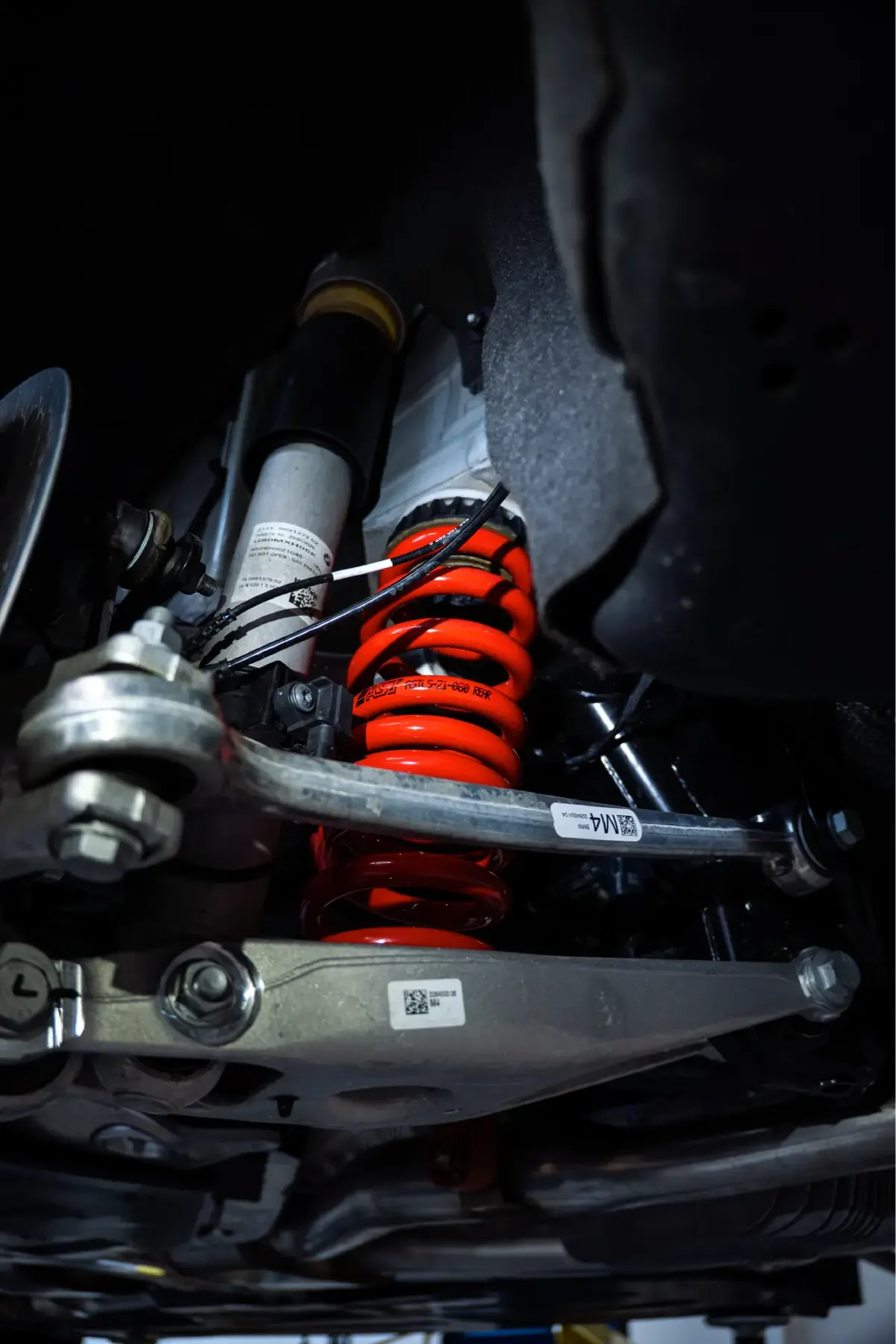
Worth knowing: Damper options differ by model year and package, and the wrong spring part number changes both the drop and how the adaptive dampers behave. Confirm the exact part for your chassis, model year, drivetrain and suspension option before you order.
Alignment and camber after lowering
Lowering a BMW moves its camber and toe. OneFastShop puts it plainly: "Every option in this article needs an alignment after install." BimmerWorld warns that with a sport spring there "may increase tire wear on the inside shoulder of the tires." Its basics page adds that "lowered cars often need the negative camber reduced to correct for tire wear," which on a larger drop can mean adjustable camber hardware.
Two practical rules:
- Set the height, then align. On coilovers, OneFastShop's advice is to set the final ride height, drive for about a week so the springs settle, then align at that height.
- Check everything that points at the road. OneFastShop reports that KW's TÜV approval for its G8x height-adjustable spring kit requires headlight aim and the driver-assistance radar and camera to be checked after lowering.
We treat the alignment as part of the job, not an optional extra, and it's covered under our wheel and tire services. If new wheels are in the plan too, settle ride height first, because offset, camber and fender clearance all interact. Our BMW wheel fitment and offset guide covers that side.
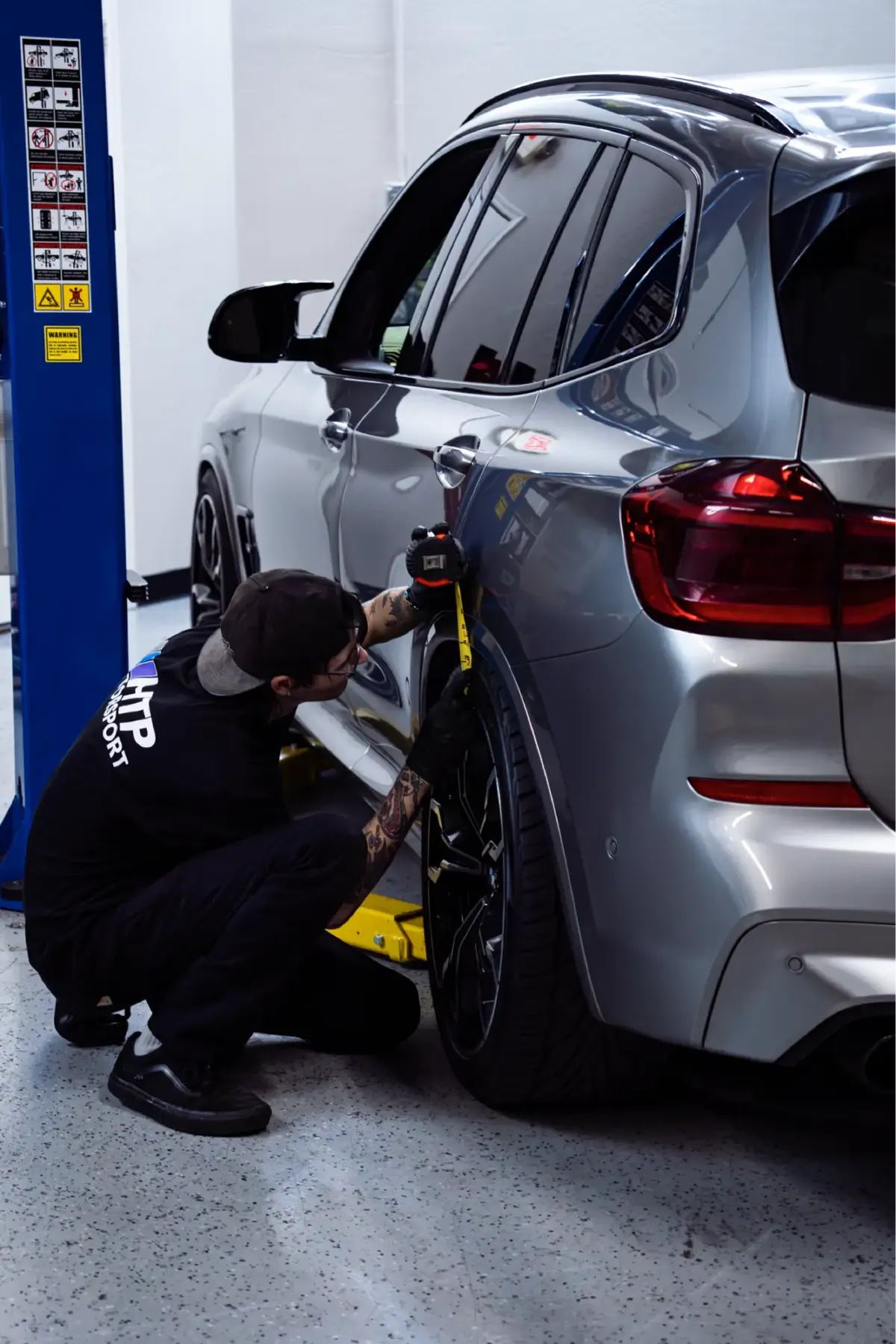
Ride quality on real roads
Lower and stiffer isn't automatically better on the street. FCP Euro is blunt about pairing a stiffer spring with a damper that can't control it: you get "a bouncy, crashy ride, which isn't very comfortable or composed." BimmerWorld's matched street packages avoid this by using dampers that are "shorter and re-valved to match the new spring rate."
FCP Euro puts the average spring drop "between an inch and an inch and a half" and says the average coilover drop "begins around an inch and a half." Going below a kit's intended range costs bump travel. OneFastShop specifically warns against setting coilovers to the bottom of the threads, where the car runs out of travel and sits on the bump stops.
Our general view for a car that's driven daily: a modest, even drop on healthy dampers rides better than an aggressive one, and it keeps the car usable on driveways and parking ramps.
Corner balancing and track use
Corner balancing means putting the car on scales, with the driver's weight accounted for, and adjusting the spring perches so weight is shared evenly across diagonal corners. That needs height adjustment at every corner, so it's coilover territory. OneFastShop's rule of thumb for choosing coilovers is a fair summary: "Track days, corner balancing, or a drop beyond 1.5 inches."
If the car is heading to track days, make the suspension decision alongside brakes, pads, fluid and tires. Our race prep work includes suspension and alignment set up for track use, and our first Arizona track day checklist covers the rest of the car.
What each path really costs
Prices vary too much between platforms to quote one number, so budget by category:
| Setup | What you're buying | Also budget for | Best fit |
|---|---|---|---|
| Lowering springs | Four springs, fixed drop | Installation and alignment; new dampers if the originals are tired | Daily driver on healthy passive dampers |
| Springs on an adaptive car | Springs listed for the adaptive option | Installation, alignment, sensor and headlight checks | Keeping adaptive damping modes |
| Height-adjustable springs | Springs on threaded perches | Installation, setting heights, alignment | Fine-tuning fender gap on adaptive cars |
| Street coilovers | Matched springs and dampers, adjustable height and often damping | Cancellation module on adaptive cars, ride-height setup, alignment | Adjustability and occasional track days |
| Track coilovers | Stiffer, more adjustable kit | Corner balancing, camber hardware, servicing on the maker's schedule | Regular track use |
For scale, OneFastShop's own storefront prices across the six cars in its comparison ran $330 to $510 for lowering springs and $1,089 to $4,094 for quality coilovers, before any cancellation kit. Treat those as one retailer's parts prices, not installed costs.
When springs are enough, and when coilovers make sense
Springs are usually enough when:
- The car is a daily driver and you want less fender gap and a little less body roll.
- The factory dampers are healthy, or they're adaptive and you want to keep them.
- A fixed drop in the range the springs offer is all you're after.
Coilovers make sense when:
- You do track days, or will soon, and want corner balancing and adjustable damping.
- You need a specific ride height for a wheel and tire package.
- The dampers are due for replacement anyway.
KW, Bilstein and Öhlins all sell into this market at different levels. The right kit is the one built for your exact chassis and the way you actually drive, not the one with the most adjustment. On a G80 or G82, our G80 M3 upgrade guide shows where suspension fits in the overall order.
Next steps
- Be honest about how the car is used: street, occasional track, or regular track.
- Identify your damper type, passive or adaptive, and confirm part numbers for your exact chassis, year, drivetrain and options.
- Plan suspension, wheels and alignment together so the car is aligned once, at its final height.
- Have the install, ride-height setup and alignment done as one job.
We install suspension as part of our performance upgrades work, whether you've already bought the parts or want help choosing them. Every project starts with a conversation and an in-person look at the car. When you're ready, book a time.