BMW Wheel Offset, Width and Tire Size: How to Choose Wheels That Fit
Offset decides whether new wheels sit flush, poke or rub, but only alongside width, tire size, center bore and brake clearance. The specs explained, with simple math to compare any wheel against the one on your BMW now.
In this article
BMW wheel offset is the number that decides whether a new set of wheels sits flush, pokes past the fender or rubs a strut. It only works alongside width, tire size, bolt pattern, center bore and the brakes behind the spokes. Below is how each spec works, the simple math for comparing any wheel against the one on your car now, and what to confirm before you pay for anything.
Start with what bolts on: bolt pattern, center bore and wheel bolts
Bolt pattern is the number of bolts and the diameter of the circle they sit on. CenCal Motorsport's guide to reading BMW fitment specs says it plainly: "A wheel with the wrong PCD physically cannot be installed." BimmerWorld's wheel tech page lists G-chassis BMWs at 5x112 with a 66.56 mm center bore, and older five-lug E-chassis cars (except the E39) at 5x120 with a 72.56 mm bore. A set of wheels from an older BMW won't simply bolt onto a G80.
Center bore is the hole that locates the wheel on the hub. Many aftermarket wheels use a larger bore. CenCal's G80/G82 wheel guide notes common bores of 72.6 mm or 74.1 mm, which call for hub-centric rings. As its fitment-specs guide explains, "Without the hub centric ring, the wheel centers on the lug bolts rather than the hub."
Wheel bolts. BimmerWorld's stud and nut page notes that "only a select few BMWs came from the factory with wheel studs," so most cars use bolts. The bolt's seat has to match the seat the wheel maker specifies, so confirm it with the wheel maker. If you add a spacer, the same page says to lengthen the bolt by the spacer's thickness.
BMW wheel offset (ET) and backspacing, explained
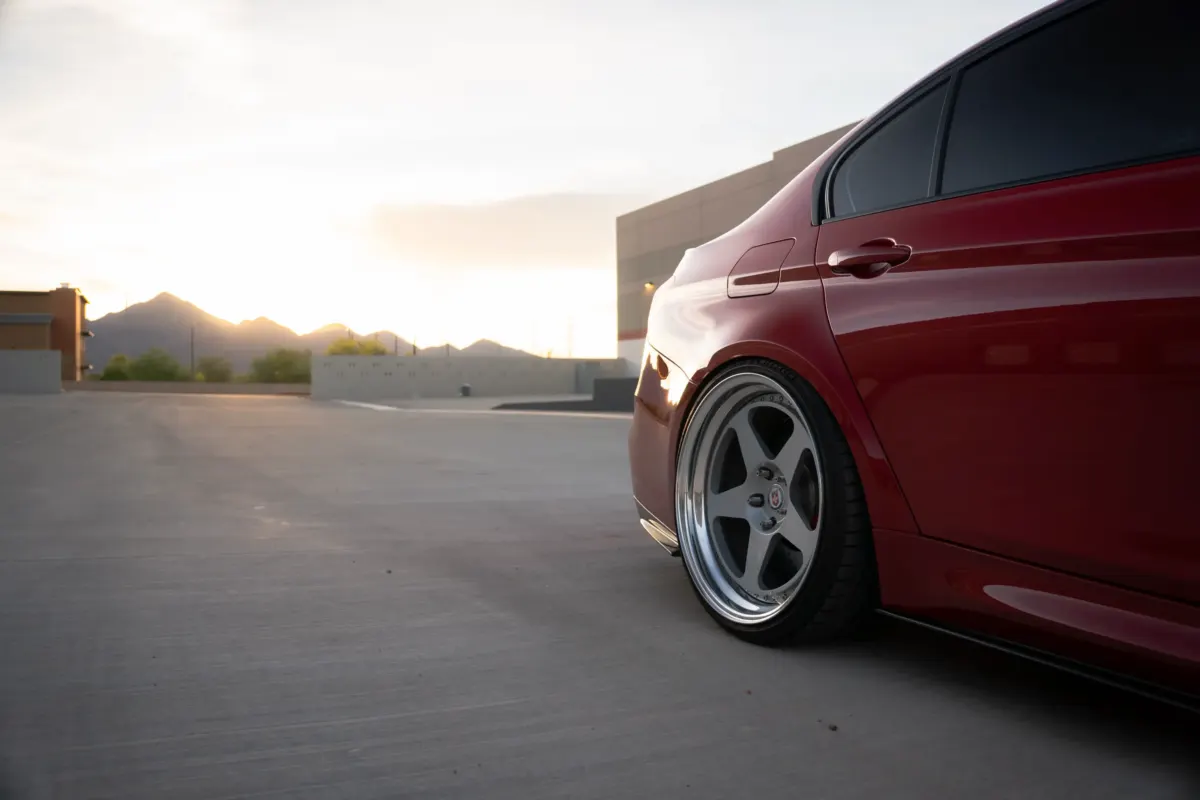
Offset, stamped as ET, is the distance in millimetres from the wheel's mounting face to its centerline. In CenCal's words, "Lower ET numbers push the wheel further outward," going too low "causes the wheel to protrude beyond the fender edge," and going too high "causes the inside of the wheel to contact suspension components."
Backspacing is the distance from the mounting face to the wheel's inner edge. It equals half the wheel's overall width plus the offset. Because the stamped width is measured at the bead seats rather than lip to lip, the easiest way to avoid errors is to compare a new wheel against the one already on the car:
- Inner edge change = half the width change + the offset change
- Outer edge change = half the width change − the offset change
Work in millimetres (1 inch = 25.4 mm). A positive inner number moves the wheel toward the strut; a positive outer number moves it toward the fender.
CenCal lists the factory G80/G82 Competition front wheel as 19x9.5 ET22. Using that as a starting point, here's how some alternatives would move. This is illustrative math, not a fitment recommendation.
| New front wheel (example) | Inner edge | Outer edge |
|---|---|---|
| 19x10 ET22 | 6.4 mm closer to the strut | 6.4 mm further out |
| 19x9.5 ET15 | 7.0 mm further from the strut | 7.0 mm further out |
| 19x10 ET25 | 9.4 mm closer to the strut | 3.4 mm further out |
| 19x10 ET28 | 12.4 mm closer to the strut | 0.4 mm further out |
The last row is the useful one. A wider wheel at a higher offset can keep the outer lip almost exactly where it was, with all the extra width going inboard toward the suspension. That's why "it's only half an inch wider" tells you very little until you know the offset.
Width and tire size: load index, speed rating and diameter
BMW's 2020 launch release for the G80 M3 and G82 M4 lists 9.5 x 18 front and 10.5 x 19 rear wheels with 275/40ZR18 and 285/35ZR19 tires, and Competition models on 19-inch front and 20-inch rear wheels with 275/35ZR19 and 285/30ZR20 tires. Michelin's tire markings guide explains the format: section width in millimetres, then sidewall height as a percentage of that width, then construction, then rim diameter in inches.
That lets you check overall diameter yourself. As an example, 275/35R19 works out to about 675 mm tall and 275/40R18 to about 677 mm. BMW's two factory front sizes land within a few millimetres of each other, and the rears do the same. Plus-sizing done properly keeps overall diameter close to stock, because the car reads road speed from how fast the wheels turn.
Two ratings matter as much as size:
- Load index. Michelin's load and speed rating guide says "A tire's load rating must always meet or exceed the value specified by the vehicle manufacturer." Going wider or lower-profile can change the load index, so check it.
- Speed rating. Michelin says replacement tires "should always meet or exceed the speed rating specified by the vehicle manufacturer." For reference, it lists Y as 186 mph.
Wheel width should sit inside the rim-width range the tire maker publishes for that size. CenCal notes that "the tire manufacturer's fitment guide specifies the appropriate rim width range for each tire size."
Square vs staggered
The factory G80 and G82 fitments are staggered, with wider wheels and tires at the rear. A square setup uses the same size at all four corners. CenCal argues that "square setups (same width front and rear) work better for tire rotation." Michelin's rotation guide adds that staggered fitments "may not allow rotation at all without a size change," and that directional tires "can only move front to rear on the same side of the vehicle."
The trade-off isn't only tire cost. Changing the front-to-rear tire width changes the car's grip balance, so we treat square versus staggered as a chassis decision. It matters most if the car also sees track days.
Brakes, poke, TPMS and weight: the details that bite
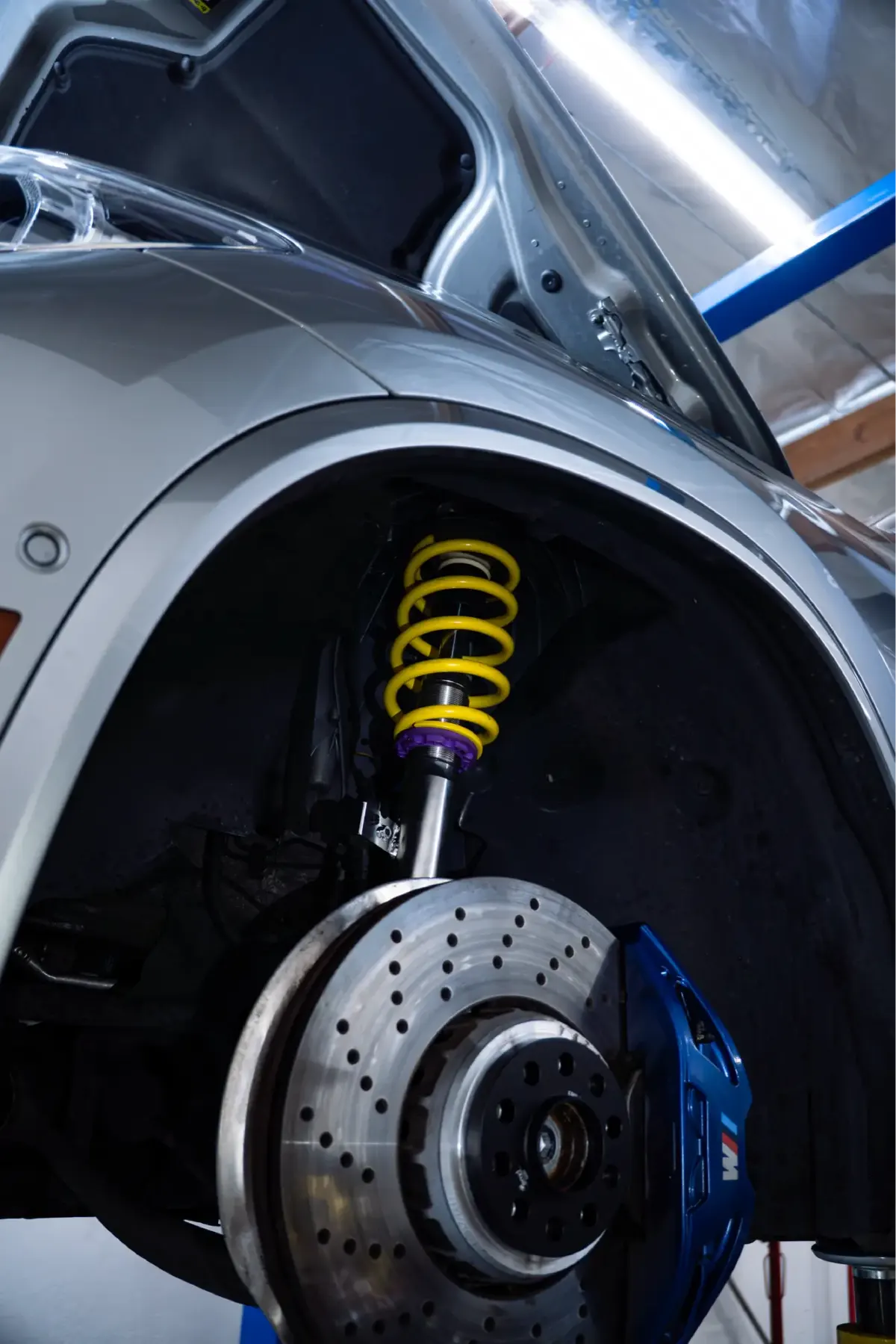
Brake clearance. BMW's release lists 380 mm front discs for the standard M Compound brakes and 400 mm front discs for the optional M Carbon ceramic brakes. A wheel that clears one package may not clear the other, and spoke shape near the caliper matters as much as diameter. Ask the wheel maker to confirm clearance for the brakes actually on your car.
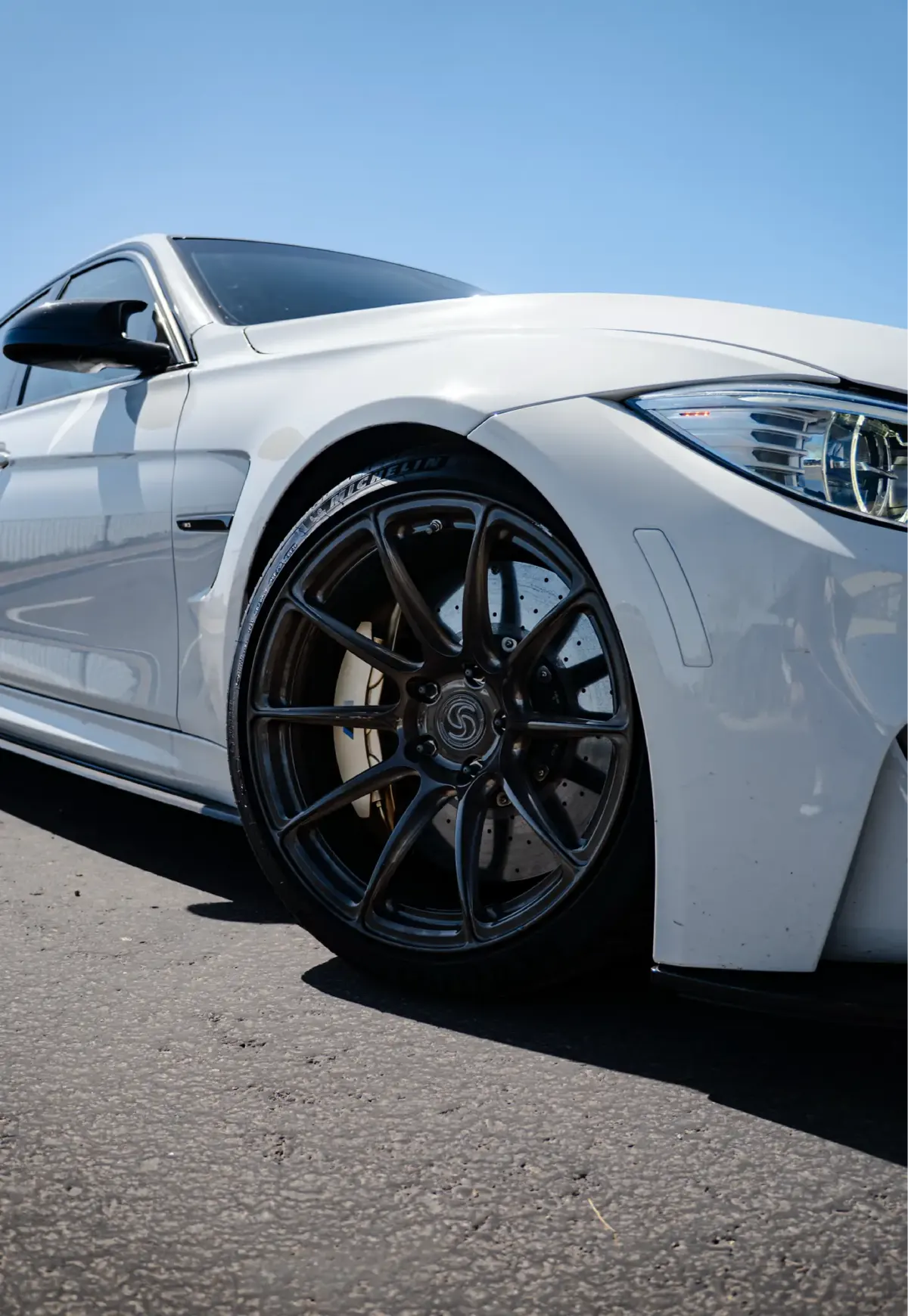
Poke and tuck. Poke is a wheel or tire sitting outboard of the fender lip; tuck is the opposite. Ride height changes both, because lowering a BMW often adds negative camber that tilts the top of the tire inward. If you're lowering the car too, settle the suspension first. Our coilovers vs. lowering springs guide covers that choice.
TPMS. Goodyear's TPMS explainer notes that tire pressure monitoring was "mandated by federal law starting September 1st, 2007," and that direct systems use sensors inside each tire. A new set of wheels needs sensors that work with your car, whether you transfer the originals or buy new ones.
Weight. CenCal says the factory G80/G82 Competition wheels "weigh 25-28 lbs each." Lighter wheels reduce unsprung and rotating mass, but published weights vary by size and finish. Ask for the maker's figure for the exact size you're buying.
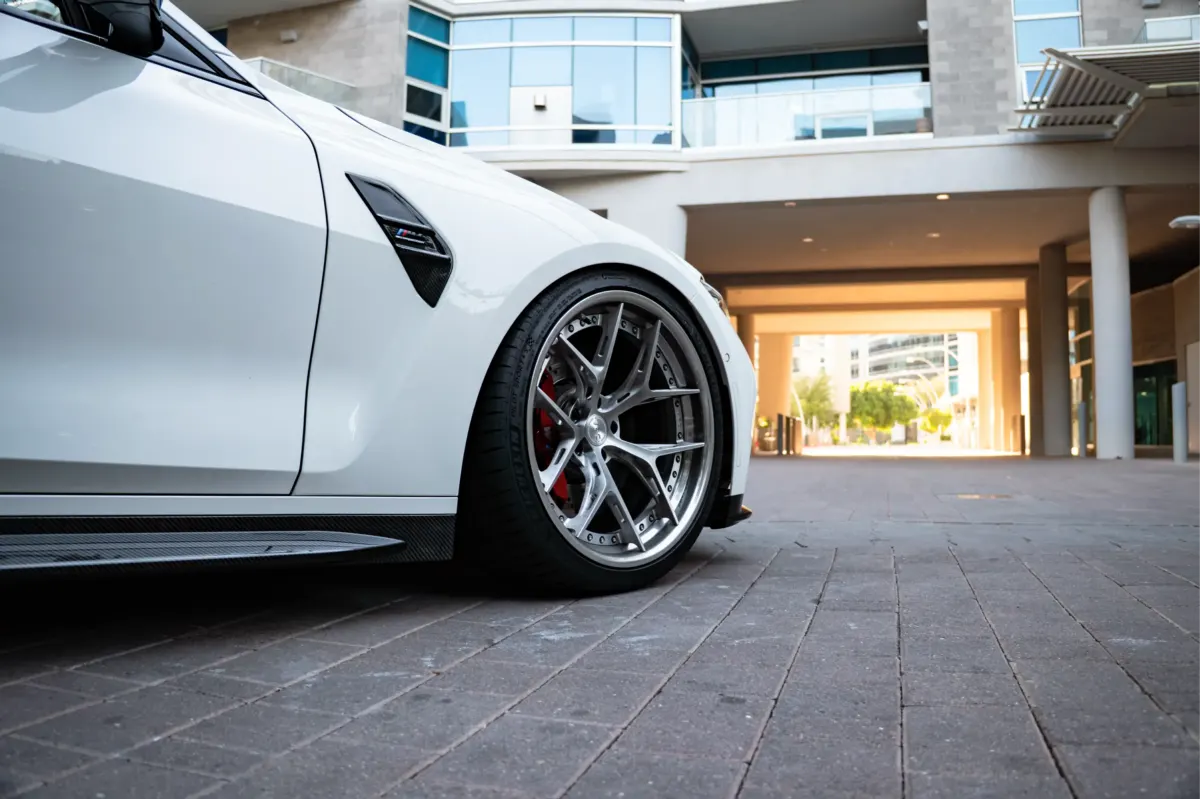
Worth knowing: Read the specs stamped on the back of your current wheels before you shop. Your own wheel is the most reliable baseline for the math above, especially on a car that has already been modified.
Before you buy: a fitment checklist
- Record your baseline. Chassis, model year, drivetrain, brake package and ride height, plus the size and ET stamped on your current wheels.
- Run the math for every wheel you're considering, front and rear separately.
- Check the tire. Rim-width range, overall diameter, load index and speed rating against BMW's spec.
- Confirm the hardware. Center bore and hub-centric rings, bolt seat and length, and TPMS sensors.
- Get brake clearance confirmed in writing by the wheel maker for your brake package.
- Plan the alignment. Any change in wheel, tire or ride height should end with one.
We can check fitment with you before you buy. Bring the car or its details, and we'll talk through the options. Our wheel and tire services cover mounting and balancing, alignments after a fitment change, wheel and tire packages, and powder coating if you'd rather refinish the wheels you have. If new wheels are part of a broader appearance plan with PPF or carbon trim, our cosmetic upgrades work can be planned in the same visit. G80 and G82 owners can see where wheels fit in the overall order in our G80 M3 upgrade guide. When you're ready, schedule a visit.