G80 M3 Upgrades in the Right Order: What to Do First on a G80 or G82, and What to Skip
The S58 rewards patience. A sequenced plan for G80 M3 and G82 M4 owners: inspection, tires and brakes, then software, then only the hardware and cooling your tune and climate actually call for.
In this article
- Know which G80 or G82 you are starting with
- Start G80 M3 upgrades with a baseline inspection
- Tires, alignment and brakes come before power
- Then the tune, and only the hardware it uses
- Cooling: what an Arizona summer changes
- Suspension and wheels, to taste
- What to skip, or at least postpone
- A sensible order for your G80 or G82
You have a G80 M3 or G82 M4, somewhere between 473 and 543 factory horsepower, and a cart full of parts. The order you do things in matters more than the parts themselves. Confirm the car is healthy, sort tires, alignment and brakes for how you actually drive, add software, and only then buy the hardware your tune and your climate call for. This guide to G80 M3 upgrades (and the G82 M4, which uses the same S58 engine) lays out that sequence and flags the parts that do little on their own.
Know which G80 or G82 you are starting with
The S58 is a 3.0-liter twin-turbo inline-six with a forged crankshaft and a closed-deck block, according to BMWBLOG's 2020 engine and drivetrain overview. What changes from car to car is output, gearbox and driven wheels, and those shape what a calibration has to account for and how the car puts power down.
| Variant | Factory rating | Gearbox | Driven wheels |
|---|---|---|---|
| M3 / M4 | 473 hp, 406 lb-ft | 6-speed manual | Rear |
| M3 / M4 Competition | 503 hp, 479 lb-ft | 8-speed M Steptronic | Rear, or M xDrive (offered from summer 2021) |
| Competition xDrive, 2025 model year on | 523 hp, 479 lb-ft | 8-speed M Steptronic | M xDrive |
| M3 CS / M4 CS | 543 hp | 8-speed M Steptronic | M xDrive |
| 2027 M3 CS Handschalter | 473 hp, 406 lb-ft | 6-speed manual | Rear |
Figures come from BMWBLOG's 2020 overview and 2025 M3 lineup guide, and BMW's releases for the 2025 M4 CS and the M3 CS Handschalter.
The platform also has an end date now. BMW says the CS Handschalter is "marking the close of the M3's sixth generation," and BMWBLOG wrote in July that the current manual M3 is "likely the last one for the manual M3 sedan as we know it." A G80 or G82 is a car worth building carefully rather than quickly.
Start G80 M3 upgrades with a baseline inspection
Before any part goes on, find out what the car is doing today. Kies Motorsports' M-car buyer's guide is a good checklist even if you already own the car:
- Running-in service. Kies tells buyers to look for "proof of the 1,200-mile running-in service."
- Previous software. Kies also lists "software or piggyback tunes" among the things to check. A new calibration should start from a known baseline, not from someone else's leftovers.
- Open campaigns. Kies advises verifying campaigns by VIN, "including limited bearing-shell delivery stops that affected small production groups."
- Wear items. Tire age, pad and rotor condition (Kies flags carbon-ceramic replacement cost), and fluid condition.
We also like to log a few pulls before changing anything: intake air temperature, oil temperature and any timing the DME pulls. Those numbers decide later whether you need cooling parts at all. Every project at HTP starts this way, with an in-person look at the car and a conversation about what you want it to do.
Tires, alignment and brakes come before power
Most G80s and G82s run out of grip long before they run out of engine. BimmerWorld's street suspension guide puts it plainly: "A better tire will probably contribute more to performance gain than any shock, spring, sway bar, or bushing." CenCal Motorsport's G80 stage 1 build list likewise puts tires ahead of new wheels when the budget is tight.
- Tires: match the compound to the use and replace aged rubber. Arizona heat is hard on tires that sit.
- Alignment: factory settings suit most street cars. If you lower the car, BimmerWorld notes that sport springs "may increase tire wear on the inside shoulder of the tires," so plan the alignment with the suspension. We handle fitment and alignment as part of our wheel and tire services.
- Brakes and fluid: for track use these come first. OneFastShop's S58 cooling guide says "a stock car heading to its first HPDE needs pads, fluid and tires before a heat exchanger."
Then the tune, and only the hardware it uses
Once the car is healthy and planted, software is the logical next step. The options are an off-the-shelf flash map, a custom calibration, or a piggyback module, and each comes with trade-offs around fuel, reversibility and warranty conversations. On newer BMWs, getting access to the DME can be its own step; we cover that in what to know before you book a BMW tune. Our performance tuning work is verified with in-house dyno time, so the result is measured, not assumed.
Downpipes: tune first, and know the law
CenCal is blunt about the most common mistake: "Downpipes without a tune. You'll get check engine lights and not realize the full benefit." On gains, BMW Tuning's S58 downpipe guide estimates roughly 15–25 whp. That is the author's estimate, not a promise.
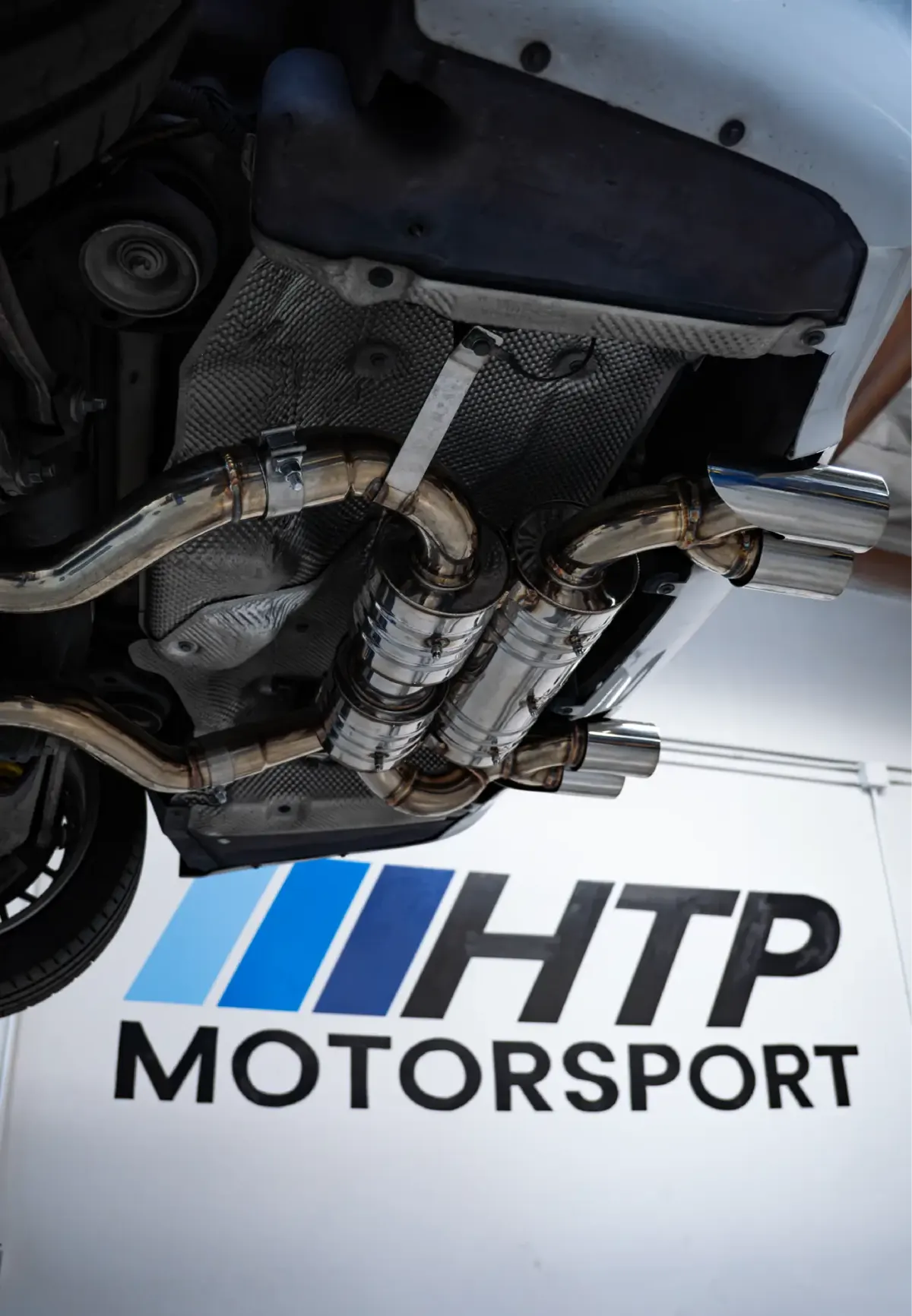
Legality matters more than the dyno sheet. Removing catalytic converters is not street legal in the US, and the same guide says catless pipes "are only intended for M2, M3, or M4 vehicles that are not road-legal or actively registered." A catted pipe isn't automatically legal either. California, for example, exempts emissions-related parts only after they have "undergone a CARB engineering evaluation," with an Executive Order that covers specific vehicles. Check the part's certification for your exact car before you buy. The sound side of this is covered in our guide to BMW exhaust upgrades.
Intake, charge pipe and intercooler
CenCal says "the factory airbox on the S58 flows very well" and puts the gain from an intake alone on a stock tune at under 5 whp, often within measurement error. It says an intercooler upgrade "only makes sense with downpipes and a tune on the S58." The same logic applies to a charge pipe: buy it when your calibration and power target call for it, not before.
Cooling: what an Arizona summer changes
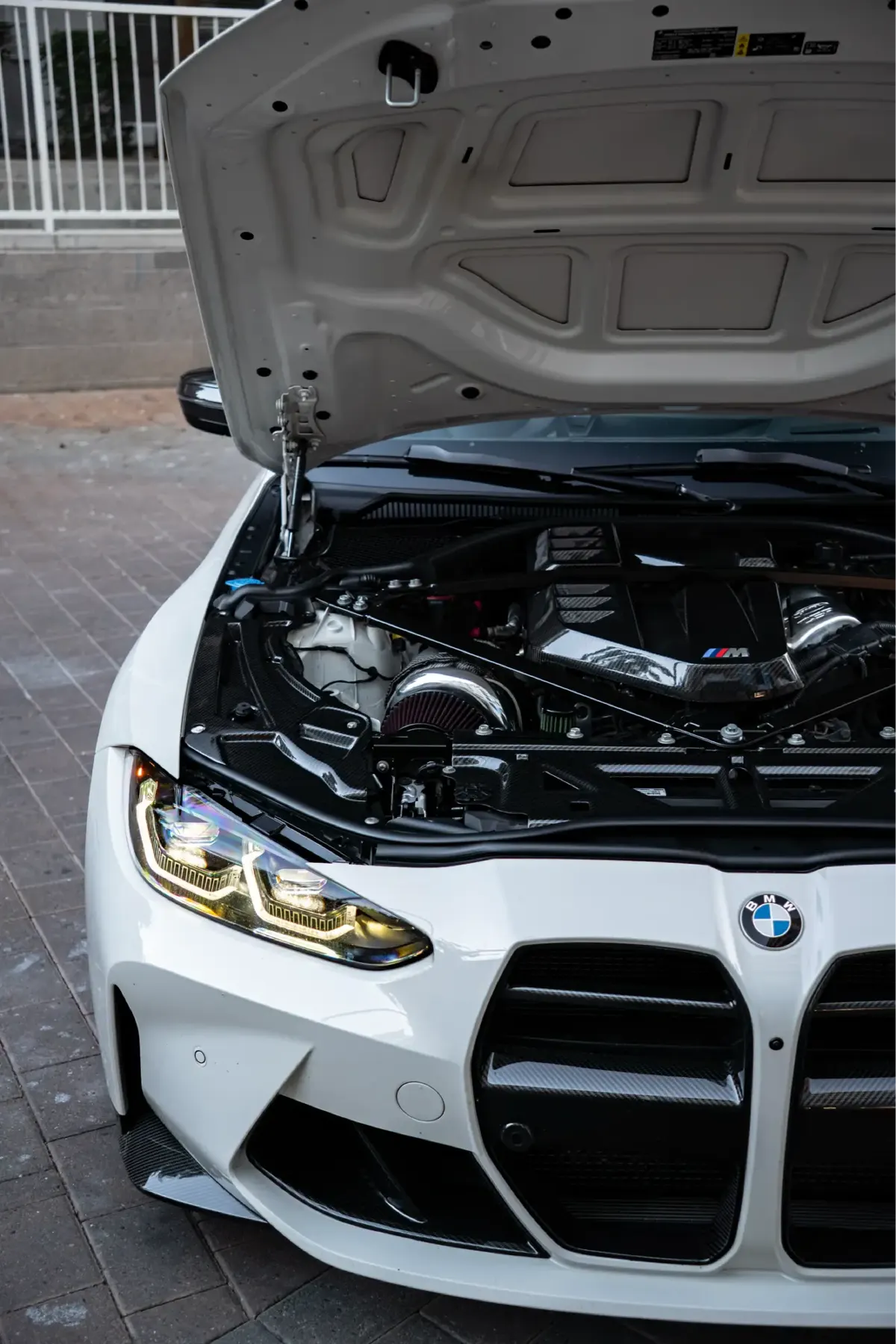
The factory system is already serious. BMWBLOG's overview lists low- and high-temperature radiators, a horizontal oil cooler and an electric fan, plus a separate transmission oil cooler on Competition models and an electric pump that keeps cooling the turbos after shutdown.
Heat soak is the issue to watch once a car is tuned. OneFastShop defines it as "intake air temperature climbing from one hard pull to the next," and says "the DME answers by pulling timing." It cites one G82 M4 owner whose oil passed 275°F after about eight laps on a 95°F day at roughly 5,000 feet, while morning sessions under 80°F were uneventful. A Phoenix summer afternoon is often hotter than that day. OneFastShop's priority order is:
- A front-mount heat exchanger, for tuned cars doing repeated pulls.
- An engine oil cooler, mainly for track use.
- A transmission cooler, on automatic cars only.
- Auxiliary radiators: "Add them when your logs show coolant climbing, not before."
It also says to skip them "if your M3, M4 or M2 is stock and lives on the street." Our Arizona heat soak guide goes deeper on desert-specific cooling.
Worth knowing: Cooling parts buy consistency, not peak power. OneFastShop's advice is to "treat any heat exchanger as a consistency part, not a power part." Your logs should justify the purchase.
Suspension and wheels, to taste
Chassis parts are about how you want the car to feel, so they can come later. For a modest budget, CenCal suggests springs and a sway bar are more realistic than full coilovers. Our coilovers vs. lowering springs guide walks through that choice.
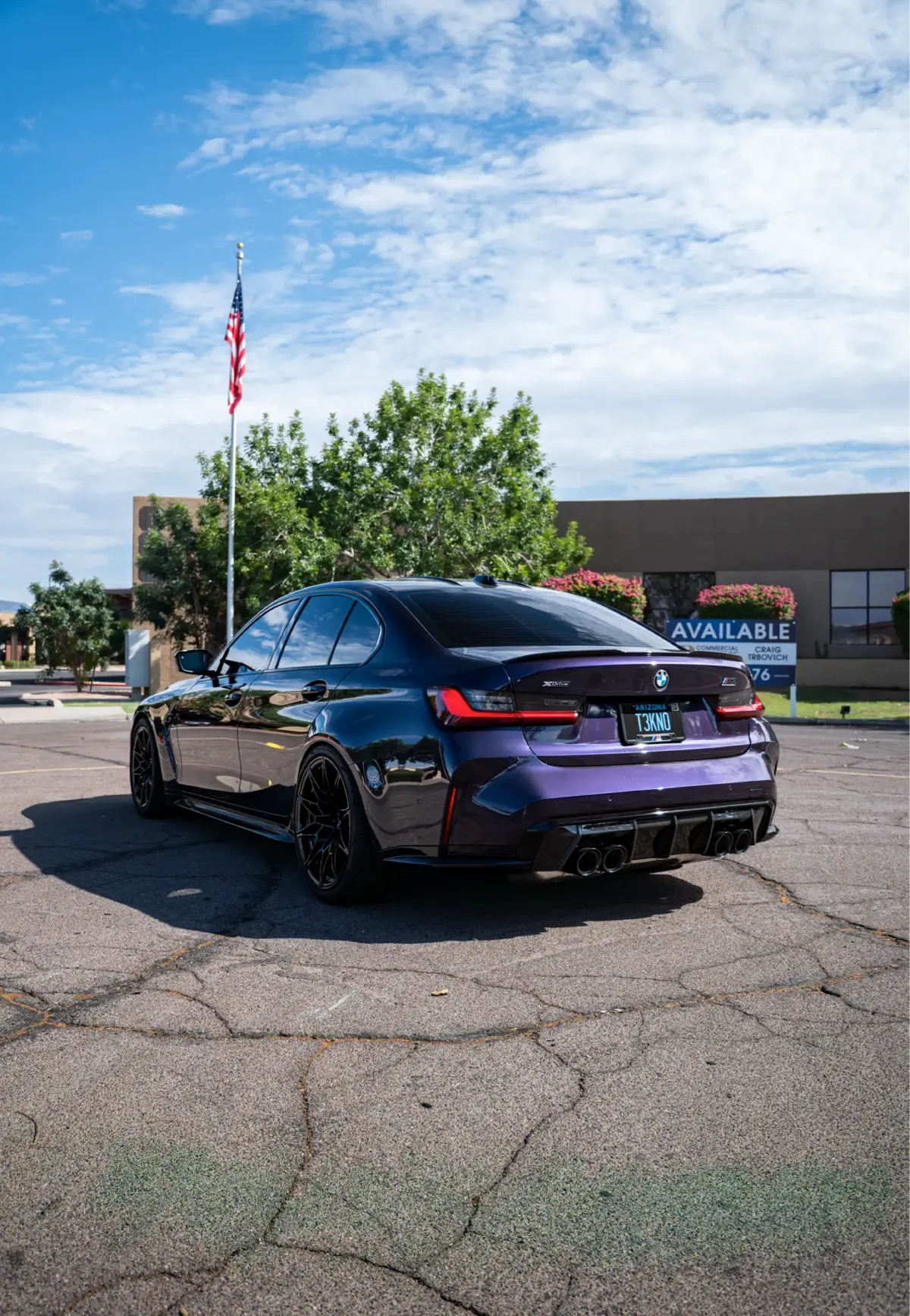
On wheels, CenCal's G80/G82 wheel guide lists the factory Competition setup as 19x9.5 ET22 front and 20x10.5 ET21 rear on a 5x112 pattern with a 66.6 mm hub bore, and puts the factory wheels at 25–28 lb each. It favors square setups for the street because they are easier to rotate. Confirm any wheel and tire for your exact model year, drivetrain and brake package before ordering.
What to skip, or at least postpone
- An intake on its own. On a stock tune the expected gain is small.
- Downpipes without a tune, and anything catless on a street car.
- An intercooler as a standalone mod.
- Cooling parts on a stock car that lives on the street. Log first.
- New wheels before good tires.
- Hardware your calibration doesn't use. Parts bought "for later" often end up being the wrong parts.
A sensible order for your G80 or G82
- Inspection, fault scan and baseline logs.
- Tires, alignment, pads and fluid for how you drive.
- A tune matched to your fuel and goals, verified on the dyno.
- Supporting hardware the calibration actually uses, legal for your car.
- Cooling, if your logs show you need it.
- Suspension and wheels to taste.
If you're in the Phoenix area and want a second opinion on your plan, HTP's performance upgrades work starts with exactly that inspection and conversation. You can book a time whenever you're ready.