BMW Exhaust Upgrades Explained: Sound, Performance, Downpipes and Daily Drivability
A valved rear section and a catless downpipe are both called exhaust upgrades, but their consequences are very different. What each section of a BMW exhaust does, what needs a tune, what drones, and what isn't street legal.
In this article
A BMW exhaust upgrade can mean a valved rear section that adds some bark at startup, or a full turbo-back system that needs a tune and, once the catalytic converters are gone, isn't legal on a public road. The way to shop is section by section. Know what each part of the system does, what changing it costs you in drone, software and legality, and buy only the sections that deliver what you actually want.
What a BMW exhaust upgrade changes, section by section
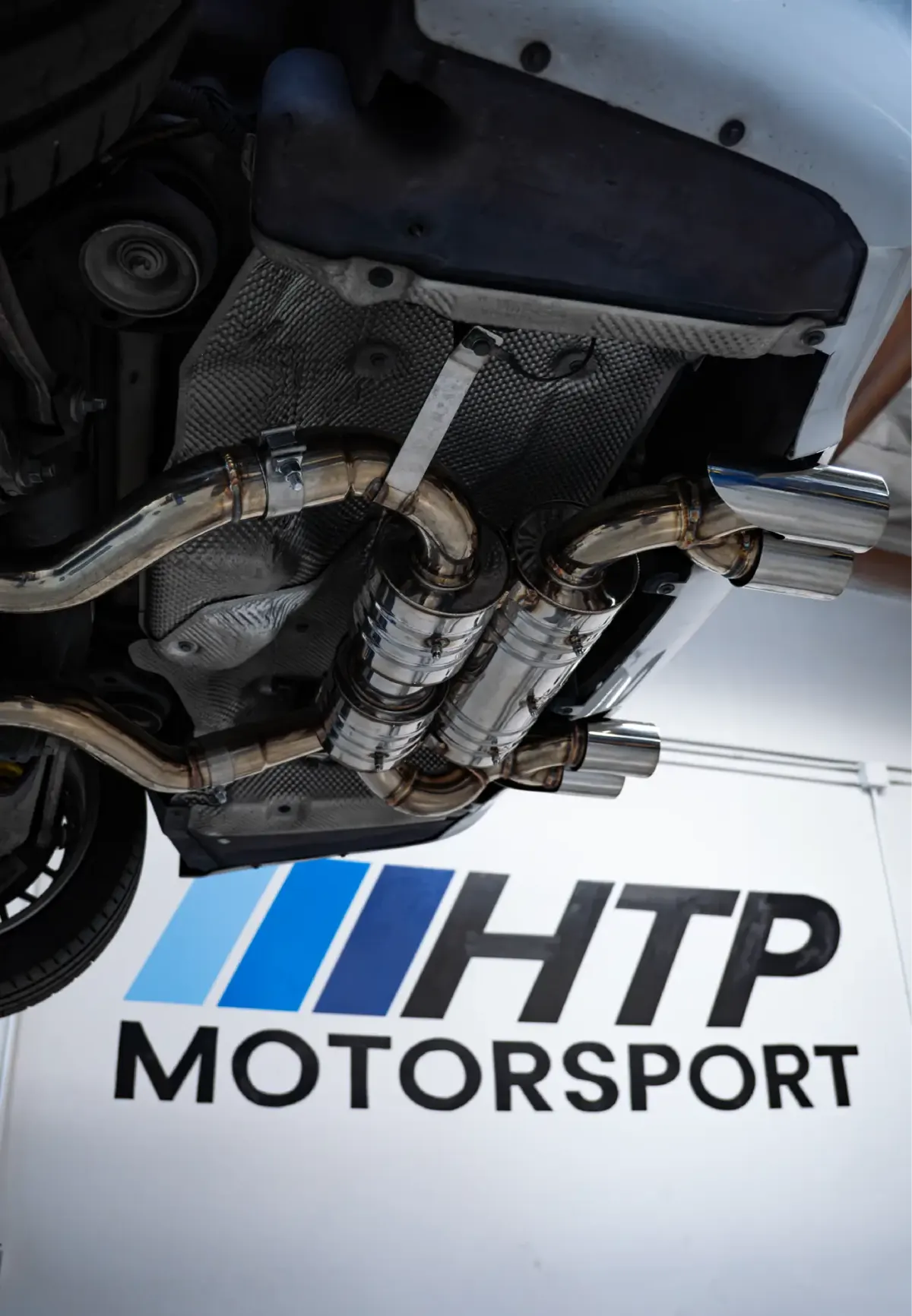
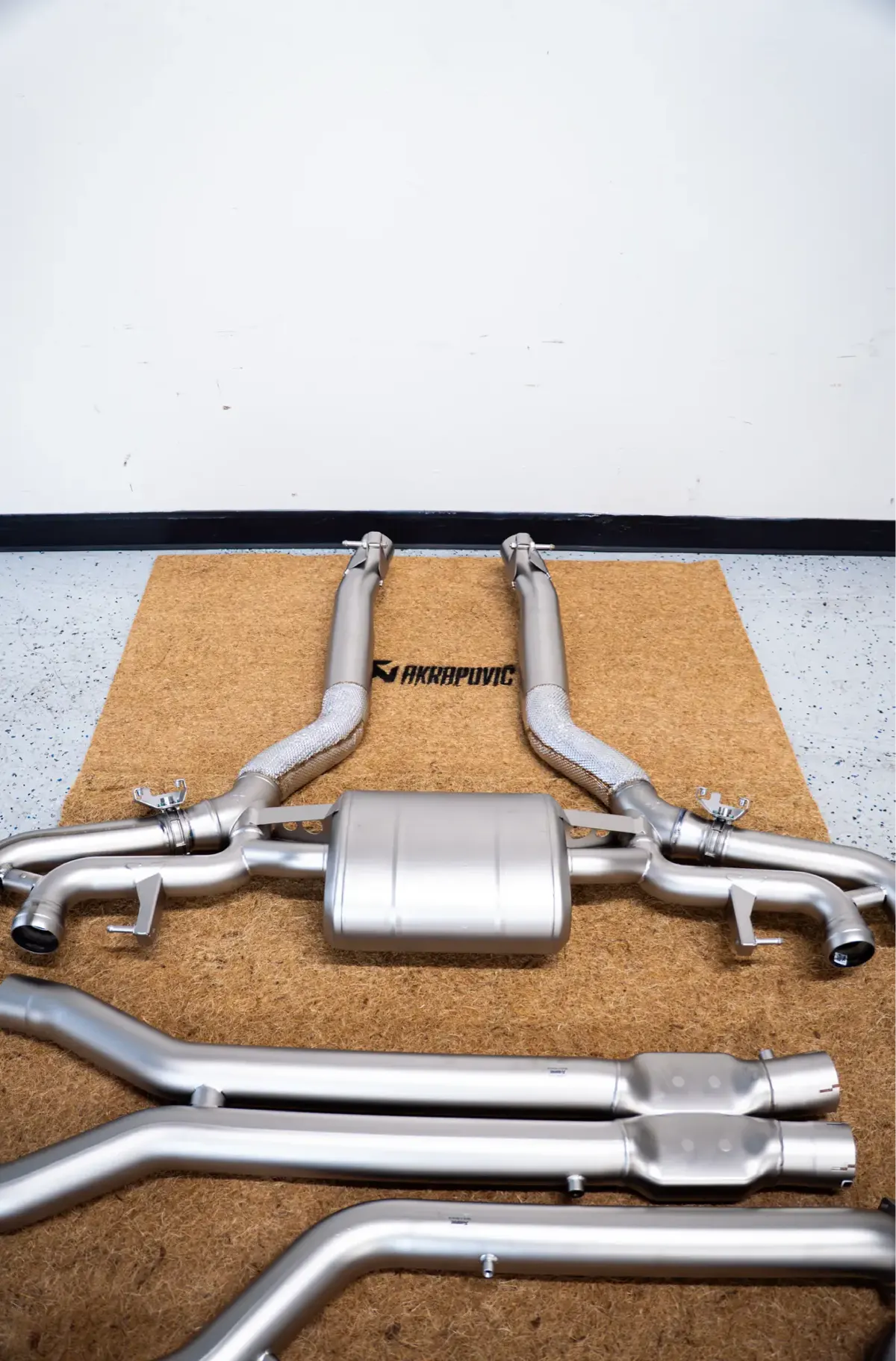
From the turbo back, a turbocharged BMW exhaust breaks into four parts:
| Section | What it does | What changing it mainly affects |
|---|---|---|
| Downpipe | Carries exhaust away from the turbo outlet; on modern turbo M cars it typically houses the catalytic converters | Flow, sound, emissions compliance, whether a tune is needed |
| Mid-pipe (center section) | Links the front of the system to the rear; often carries resonators | Volume and cabin drone |
| Rear section | Mufflers and, on M cars, electrically controlled valves | Sound character, valve behavior, weight |
| Tips | Finish the system at the bumper | Appearance |
The further forward you go, the more a change affects the engine's calibration and the car's emissions equipment. The further back you go, the more it's about sound.
Downpipes: where the power, the tune and the legal problem live
The downpipe is the section most closely tied to performance, and also the one with the most strings attached.
It usually needs a tune. CenCal Motorsport's G80 exhaust buyer's guide is blunt: "You need a tune for catless downpipes. Period." It adds that "running catless without a tune will throw check engine codes." Parts makers say the same for other BMW engines: CTS Turbo's B58 Supra downpipe listing states that "Stage 2 software is required to avoid check engine light." A downpipe is therefore a tuning decision, not a bolt-on. Our B58 tuning guide covers how software and hardware are matched on that engine. On any car, the calibration should be verified rather than assumed, which is why our performance tuning work is checked with in-house dyno time.
Removing the catalytic converters isn't street legal. The U.S. EPA's defeat-device enforcement page notes that required emission controls "often include filters and catalysts installed in the vehicle's engine exhaust system," and states that "the CAA prohibits tampering with emissions controls, as well as manufacturing, selling, and installing aftermarket devices intended to defeat those controls." Arizona law says the same thing at state level: ARS 28-955 requires vehicles from the 1968 model year on to be equipped with emissions control devices. CTS's own listing says its catless pipe "is sold for competition use and is not legal for use in highway or street vehicles."
A catted downpipe isn't automatically legal either. Requirements vary by part. Milltek, for example, says the sports-cat downpipes in its European M3 Touring system "do not require ECU tuning (no Cel)." But that's a European system, and European approvals (Milltek cites ECE and TÜV for it) don't make a part legal on a US road. In the US, the California Air Resources Board explains that an Executive Order "allows the modification to be installed on specific emission controlled vehicles," with a number that can be verified. The EPA's enforcement discretion notice allows California-approved aftermarket catalytic converters to be sold and installed in other states. If a part has no approval for your exact car, assume it isn't street legal.
Worth knowing: "Off-road" or "competition use only" labels don't change the law for a car you drive on public roads. Decide whether the car is a street car or a dedicated competition car before a downpipe goes in your cart.
Mid-pipes, resonators and drone
Drone is the low, booming resonance that builds in the cabin at a steady cruising rpm, and it's the thing most likely to make a loud exhaust tiring to live with. BMW engineers the factory system around it. The G80 M3 and G82 M4 launch release says the car's "electrically controlled flaps provide comfortable sound levels by reducing intrusive sound frequencies."
Resonators do a similar job passively. Milltek's G8X range is offered as "ECE Approved Resonated," "Part-Resonated" and "Non-Resonated," and the company frames the choice as "whether you want something louder, with the removal of resonators." In our view, a resonator delete is the change most likely to turn a fun car into a tiring one on a long freeway drive. If the car is a daily driver, start with a resonated or part-resonated section.
Valved rear sections and how valve control works
On recent M cars the factory valves already set much of the car's character. BMW's 2013 F80/F82 release describes "electrically controlled flaps just before the rear silencer" that "minimize exhaust back-pressure." On the G80 and G82, BMW says Sport and Sport+ modes turn up "the intensity of the exhaust sound," and an M Sound button lets the driver "reduce engine note when desired."
Most aftermarket valved rears are designed to keep those controls:
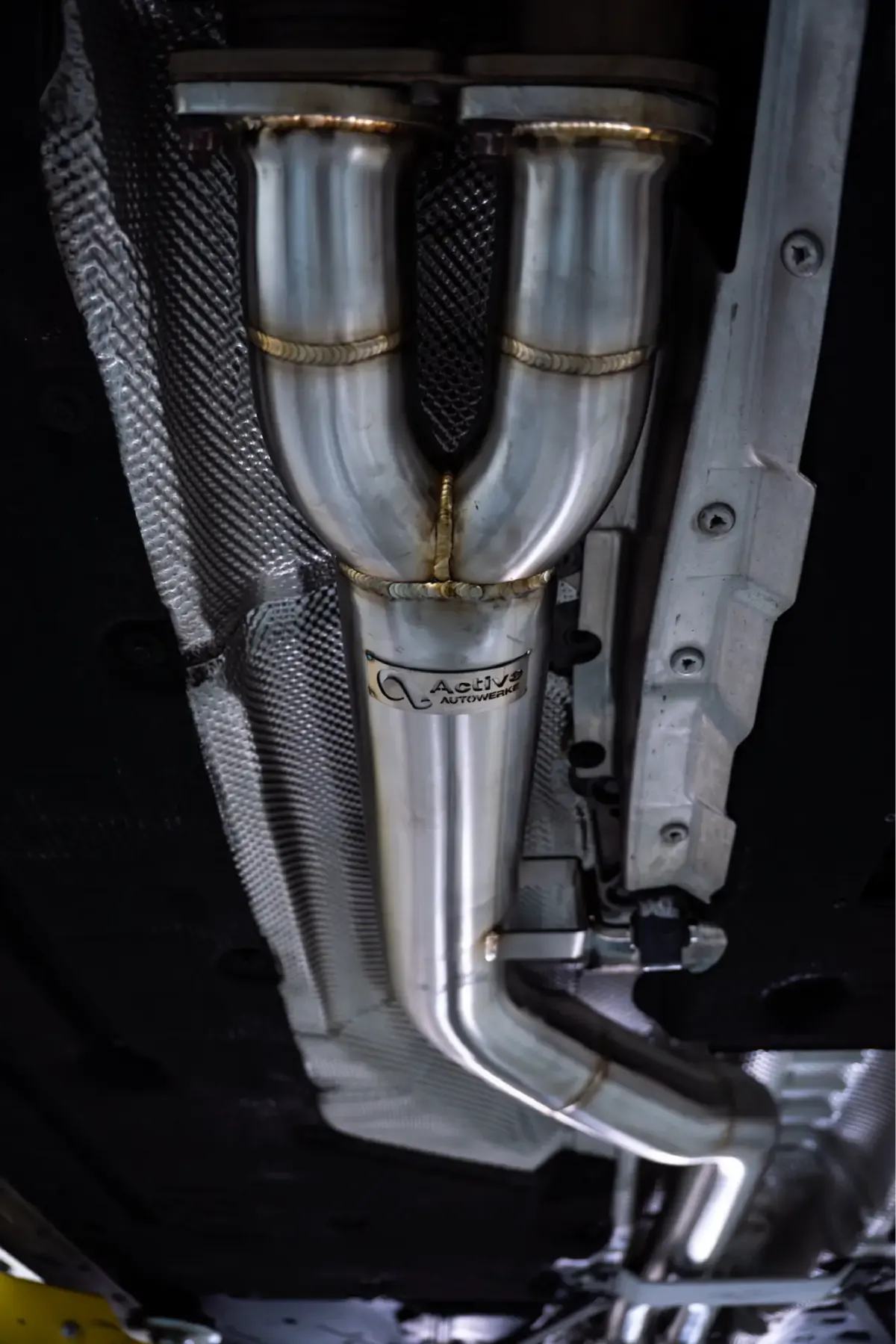
- BimmerWorld's listing for the Active Autowerke valved rear for the G80 and G82 says it "is compatible with the stock valve control system" and is "constructed of 304 stainless steel." The seller describes the sound as "only moderately higher than stock, avoiding annoying drone in the cabin." It's a cut-and-clamp installation, and the listing recommends replacing four rubber hangers at the same time.
- Milltek says its M3 Touring valves work "with either the factory OE valve control functionality or the plug-and-play Milltek Sport valve control system."
- CenCal sums up the market: "Most valved systems work through the stock BMW exhaust valve controls or via a separate switch."
Confirm which applies to your exact model year before you buy. A system that keeps factory valve control also keeps your quiet mode.
Stainless or titanium?
Most aftermarket BMW systems are stainless: Milltek uses T304L, and the Active Autowerke rear above is 304. Titanium costs more and weighs less. CenCal estimates that a stainless G80 cat-back "saves about 8-12 lbs over stock depending on brand," and that titanium "saves another 10-15 lbs over stainless and develops a blue heat tint on the tips over time." It also says titanium's sound characteristics are "nearly identical to stainless on the same design." Treat those as one retailer's estimates. Ask the maker for the actual weight of the system you're considering.
Sound, neighbors and Arizona law
Louder isn't free. ARS 28-955 requires "a muffler that is in good working order and that is in constant operation to prevent excessive or unusual noise," says "a person shall not use a muffler cutout, bypass or similar device on a motor vehicle on a highway," and sets a civil penalty of at least $100. Beyond the law, there's living with it: early cold starts in an apartment complex or a quiet street win you no friends. A system that keeps the factory valves, plus BMW's M Sound button where fitted, lets you choose when the car is loud.
What to do next
- Decide the goal. For sound and a little weight, start at the rear section and consider the mid-pipe second. For power, the downpipe is a tuning decision. Our G80 M3 upgrade guide shows where it fits in the order on an S58 car.
- Keep the catalytic converters on a street car, and check the approval status of any catted part for your exact car.
- Confirm fitment for your model year, body style and drivetrain, and whether the valves run off factory control.
- Plan the install. Cut-and-clamp or bolt-on, new hangers and gaskets, and, if a tune is involved, time on the dyno to verify it. Tuned cars that live in the Valley should also read our guide to heat soak.
We install exhaust hardware as part of our performance upgrades work, whether you bring your own parts or want help choosing them, and we can sequence it with any tuning. Every project starts with a conversation and an in-person look at the car. When you're ready, book a time.