BMW B58 Tuning Explained: What Owners Should Know Before Modifying
The B58 responds well to a tune, but which version you have, what "stage 2" really involves, and a few known weak points matter more than the number on a forum post. Here's what to sort out first.
In this article
The B58 is BMW's 3.0-liter turbocharged inline-six, found in everything from the 340i and M240i to the X3 M40i, and in the Toyota GR Supra. BMWBLOG notes that tuners have nicknamed it "BMW's modern 2JZ." Successful B58 tuning starts before any software goes on the car. You need to know which version of the engine you have, what "stage 1" and "stage 2" actually involve, which known weak points to deal with first, and where the legal line sits once downpipes enter the conversation.
Which cars use the B58, and which version you have
According to BMWBLOG's B58 vs S58 comparison, the B58 "arrived in 2015 in the F30 340i" and has since powered the M240i, Z4 M40i, M340i, 740i and X3 M40i, among others. The hardware basics come from the same article. The B58 uses "a single twin-scroll turbocharger," "a closed-deck block," "a forged steel crankshaft," and "a water-to-air intercooler integrated into the intake plenum." Outside BMW, The Autopian names the Toyota GR Supra and the Ineos Grenadier as B58 users.
The engine has changed over that time, and the version matters for tuning. BMWBLOG describes a 2018 update, commonly called the B58TU, that raised injection pressure "from 200 bar to 350 bar." It also replaced the two-piece timing chain with a single unit and split the cooling system "into separate circuits for the block and cylinder head." The newest versions add 48-volt mild-hybrid hardware. BMW lists the 2025 X3 M50's engine as the B58B30M2, with "393 hp" of total system output and a crankshaft-mounted starter generator (BMW Group press release). The 2026 M340i xDrive 50 Jahre Edition is rated at 386 hp with 48-volt mild-hybrid technology (BMW).
| Version | Examples named by the sources | What it changes for tuning |
|---|---|---|
| Gen 1 | Every US B58 from the 2016 340i through the 2019 model year, per OneFastShop | Factory plastic charge pipe is a "documented crack point once boost goes up" (OneFastShop) |
| B58TU (Gen 2) | G20 M340i and A90 GR Supra, among others, per OneFastShop | Higher injection pressure, revised timing chain and split cooling (BMWBLOG); later DMEs may need unlocking |
| 48V mild-hybrid B58 | 2025 X3 M50, 2026 M340i (BMW) | Newest version; confirm tuning support for the exact car before buying parts |
B58 tuning stages: stage 1 vs stage 2 in plain terms
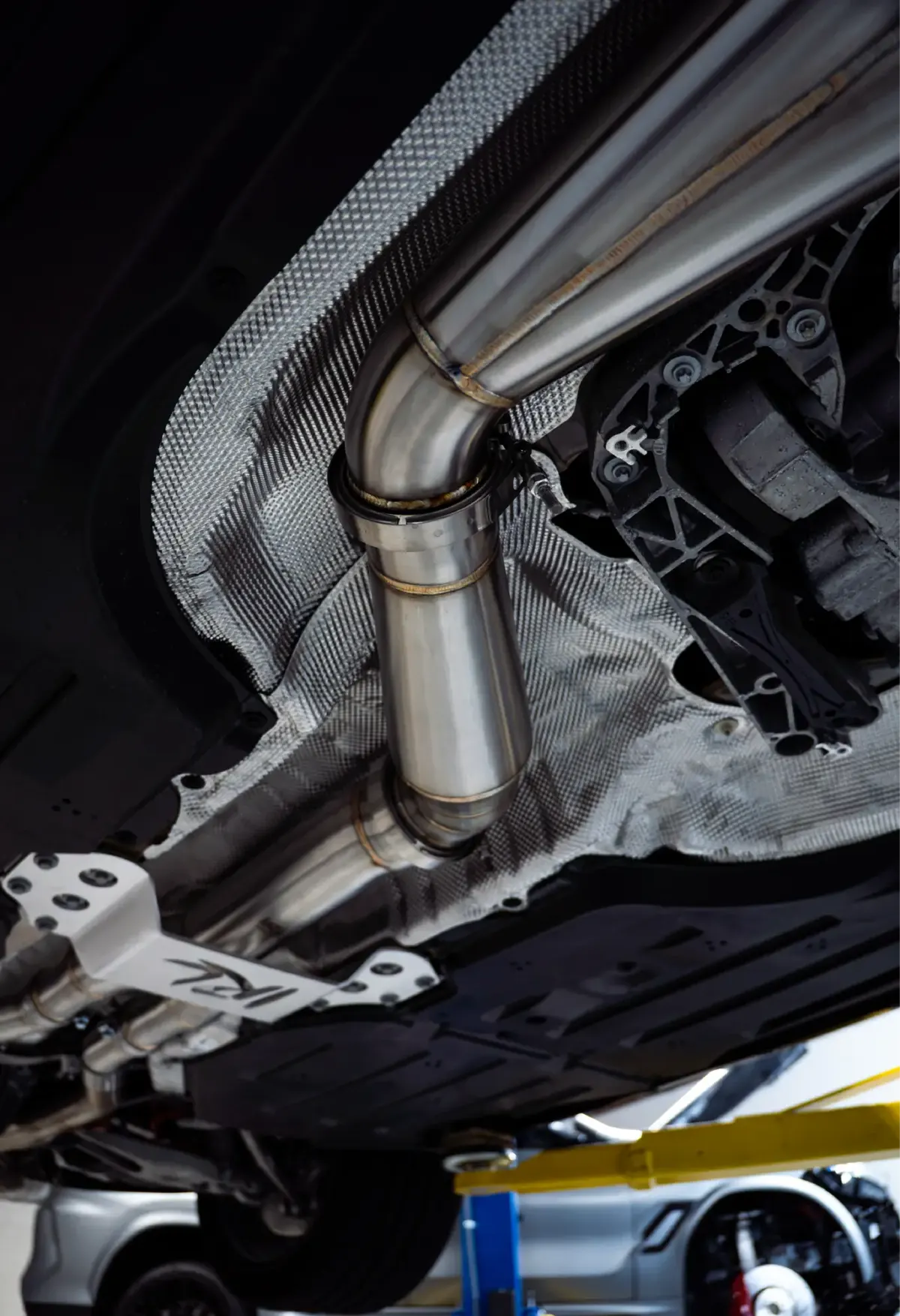
"Stage" is a convention, not a standard, and different vendors draw the lines differently. One clear version comes from OneFastShop, a parts and tuning retailer, in its B58 stage guide: "Stage 1 is a map written for the factory downpipe." "Stage 2 is a map written for a high flow or catless downpipe." By its account, stage 2 "needs exactly one new part," the downpipe, though on Gen 1 cars it treats an upgraded charge pipe as required too. A heat exchanger is "strongly recommended" at stage 2, and an intake is optional at either stage.
The vendor flags the charge pipe as the main generational difference. "The Gen 1 plastic pipe (F22, F30, F32, pre 2020 G30) is a documented crack point once boost goes up." On those cars, it says, an upgraded pipe "goes on before the Stage 2 map, not after the first crack." On B58TU cars it reports the opposite pattern from owners, with some saying aftermarket pipes leaked more than the factory part.
What will a tune make? BMWBLOG says a tune alone "can push a B58-powered M340i past 400 horsepower with relatively little stress on the engine." Treat that as one publication's observation, not a target. Your result depends on the engine version, the fuel you run, the calibration, the condition of the car and the air temperature on the day. That last one is a real factor in Arizona, as our heat soak guide explains.
Downpipes and the law
This is where you have to be precise. OneFastShop states it plainly: "A catless downpipe is not street legal anywhere in the United States." Federal law makes it a violation "for any person to remove or render inoperative any device or element of design" installed for emissions compliance (42 U.S.C. § 7522). It also bars selling or installing parts whose principal effect is to defeat those controls. For catted pipes, the same retailer says a part is emissions legal in a state only when it "carries a CARB Executive Order or EPA verification," and says it knows of no B58 downpipe with that certification. The California Air Resources Board explains that an EO number can be verified by Smog Check stations. In Arizona, ADEQ requires emissions testing in the Phoenix and Tucson metro areas, and the test includes an on-board diagnostic check.
Fix these before you add power
A tune puts more load on everything. Start with a car that is dry, healthy and free of stored faults.
- Oil filter housing. The Autopian explains that BMW made the B58's filter housing out of plastic, even though it handles hot oil and coolant. It says "the plastic can simply get brittle and crack over time," leaking oil, coolant or both. It estimates the repair at "anywhere from an $1,800 bill to a $3,500 bill" with labor. Its watch list includes older M240i, 340i, 440i, 540i, 740i, X3 M40i and X4 M40i.
- PCV and valve cover gasket. BMWBLOG calls these "known weak points," and lists the "plastic coolant expansion tank" as another item to watch.
- Stored codes and leaks. A scan and a look underneath cost far less than tuning around a fault. Our diagnostic process comes before any repair, and repair and service work can handle anything found before the tune goes on.
Supporting mods, cooling and the transmission
Cooling
The B58's water-to-air intercooler sheds its heat through a front-mounted heat exchanger. OneFastShop's view is that "a heat exchanger keeps the number on the third pull." It adds that a stage 2 B58 "loses power on repeated pulls" when the factory heat exchanger can't keep up. If you drive in the Phoenix summer or plan track days, budget for cooling alongside the tune, not after it.
Fuel
The vendor notes that the engine generation "changes your fuel ceiling." If ethanol blends are part of the plan, remember that E85 isn't a fixed recipe. The U.S. Department of Energy defines it as "51% to 83% ethanol, depending on geography and season." Any flex-fuel setup has to measure what's actually in the tank rather than trusting the pump label.
Transmission
If your B58 car is an automatic (BMW lists an "8-speed Steptronic transmission" on the 2026 M340i, for example), more torque means more heat and load in the gearbox, and Kies Motorsports reports that ZF's guidance is to "shorten the interval under high temperature, high load." Kies's own suggestion for tuned street cars is a fluid service every 40,000 to 50,000 miles. Ask whoever tunes your car whether the transmission calibration is part of the plan, and what torque the drivetrain is being asked to handle.
Brakes, tires and chassis
Power is the easy part. If the car is getting faster, look at pads, fluid and tires at the same time, and read our suspension comparison before you lower it.
Newer cars: check whether the DME is locked
Later B58 cars add a step. OneFastShop relays one tuning-software developer's position that "DMEs produced after June 2020" need a bench unlock, which means the engine computer has to come out of the car for the unlock. The retailer estimates US unlock services at "about $800 to $1,600." That's a vendor's figure, and it varies, but it belongs in the budget. It also means extra downtime, so ask about it before you book anything else.
A sensible order for a B58 build
- Identify the engine version and the DME production date so you know whether an unlock is needed.
- Get a health check: scan for codes, inspect the oil filter housing, PCV, valve cover and coolant tank, and fix leaks first.
- Decide what has to stay street legal. That decision shapes every hardware choice after it.
- Tune with logging and verification. At HTP, performance tuning is verified with in-house dyno time.
- Add cooling and supporting hardware as the logs show the need, through our performance upgrades work. You're welcome to bring your own parts.
If you own an S58 car instead, our G80 M3 and G82 M4 upgrade guide covers that engine. For a B58, you can book a consultation at the Tempe shop, and we'll look at the car and your goals before recommending a stage.